Somnath has been destroyed and rebuilt at least seven times. The history of these reconstructions is the history of India's civilizational persistence.
When Sardar Vallabhbhai Patel stood at the ruins of Somnath in November 1947 — three months after India's independence — the temple had been a heap of rubble for two hundred years. His pledge to rebuild it, honoured with the consecration of the seventh temple on 11 May 1951 by then-President Dr. Rajendra Prasad, closed a story of resistance and restoration that had run for over a thousand years. This is the timeline of Somnath's seven reconstructions, drawn from Puranic sources, medieval chronicles, colonial archaeological reports, and the Somnath Temple Trust's own records.
Somnath's history is unusually well documented for an Indian temple because it kept attracting the attention of chroniclers — Chinese Buddhist pilgrims in the 7th century, Arab historians in the 11th century, Portuguese sailors in the 16th century, and British administrators in the 19th century. Piecing together the seven reconstructions is therefore possible with more historical certainty than for most Indian shrines of comparable antiquity.
First Temple: Pre-Common Era
Puranic tradition attributes the first Somnath to the Moon God Chandra himself, built in gold, followed by a silver reconstruction by the Sun God and a wooden one by Lord Krishna. Historical evidence is scarce but the site is mentioned in the Rigveda under the name Prabhasa, suggesting continuous worship since at least 1500 BCE. Archaeological surveys in the 1950s uncovered pottery shards at the Prabhas Patan site dating to circa 1200 BCE, giving physical support to the Puranic dating.
Second Temple: 7th Century — Stone by the Maitraka Dynasty
The first attested stone temple was built by King Bhattarka of the Maitraka dynasty of Vallabhi around 649 CE. Chinese pilgrim Xuanzang mentions it in his travelogue Xiyu Ji — the earliest external documentation of a temple on the site. Xuanzang describes it as a "Shiva shrine at the western sea" attracting devotees from across northern India, suggesting it was already a major pilgrimage centre by the 7th century. This temple stood for over three centuries before being sacked by Arab raiders in the 8th century.
Third Temple: 10th Century — Chalukyan Grandeur
The Solanki king Mularaja rebuilt the temple around 950 CE in the emerging Chalukya-Solanki style — the same architectural tradition that would later produce the Modhera Sun Temple. This is the version that Mahmud of Ghazni sacked in 1024 CE, a raid that removed an estimated 20 tonnes of gold and 200 maunds of silver from the temple treasury according to the contemporaneous Persian chronicler Al Biruni. The temple structure was damaged but not destroyed; devotees performed daily worship even amid the ruins, and the trust records show that gold offerings resumed within a decade.
Fourth Temple: 11th Century — Kumarapala's Restoration
Solanki king Kumarapala rebuilt Somnath in a grander scale between 1143 and 1172 CE. This is arguably the peak of medieval Somnath — the temple as recorded by 12th-century travellers stood 15 stories high with 14 gold-plated kalashas and a shikhara that dominated the coastal skyline for miles. Kumarapala's temple was famously described by the Jain monk Hemachandra as "the most beautiful stone structure west of Konark", and its architectural drawings survive in the temple trust's archives, forming the basis for later reconstructions.
Fifth Temple: 13th Century — Vaghela Dynasty
After a 1299 CE raid by Alauddin Khilji's general Ulugh Khan destroyed the Kumarapala temple, the Vaghela king Chudasama rebuilt it in the 1310s. This version was smaller and more austere, built with an eye to being defensible rather than ornate. The Vaghela reconstruction lasted through most of the Sultanate era before being seriously damaged in the mid-15th century Muzaffarid raids, though daily worship continued through the damage.
Sixth Temple: 18th Century — Rani Ahilyabai Holkar
After a 1665 CE demolition ordered by Aurangzeb, Somnath lay in ruins for almost a century. The great restorer of Hindu temples across North India — Maharani Ahilyabai Holkar of Indore — built a smaller parallel temple near the ruined main site in 1783 CE. Her temple was deliberately modest — she chose to build alongside the ruins rather than on them, preserving the ruined main temple as a memorial. This gesture is now considered one of the most emotionally significant acts in the temple's history. Her temple functioned as the operating Somnath through the British period.
Seventh Temple: 1951 — The Republic's Restoration
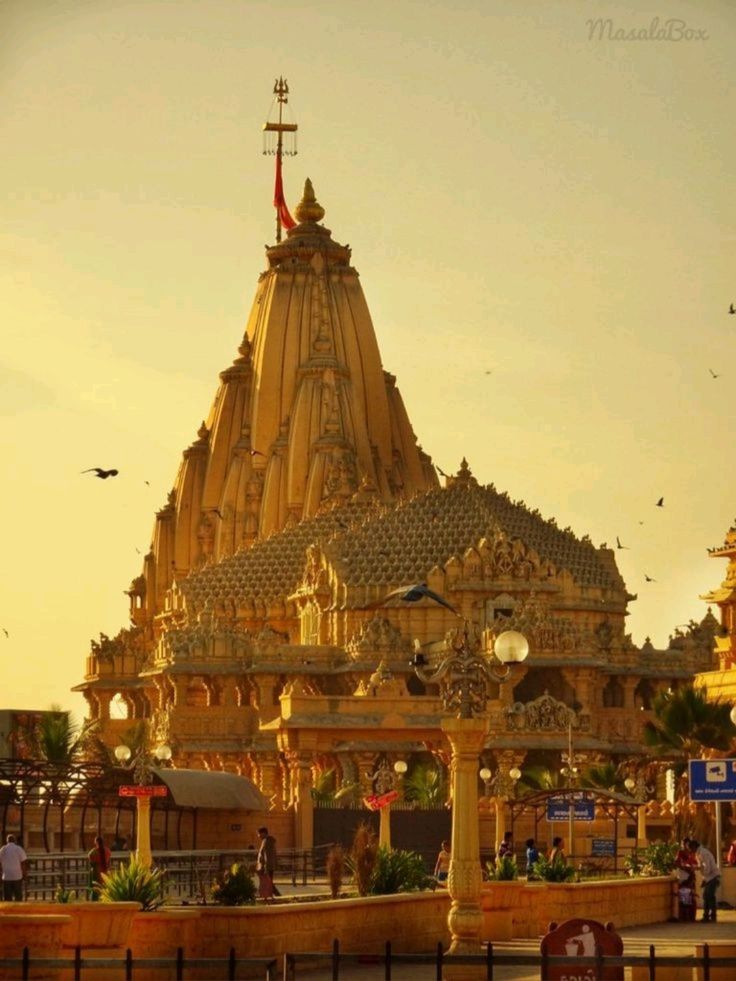
Sardar Patel visited the ruins on 13 November 1947 and pledged reconstruction; the foundation stone was laid on 8 May 1950 by K.M. Munshi (author of "Jai Somnath", the seminal Gujarati novel about the temple's history) and the temple consecrated on 11 May 1951 by President Rajendra Prasad. The design — a seven-storied 155-foot shikhara in Chalukya-Solanki style — deliberately echoes Kumarapala's 12th century peak version. The Baan Stambh (arrow pillar) on the seaward side famously marks that there is no land in a straight line between Somnath and the South Pole; the pillar was installed as part of the 1951 reconstruction as a symbolic marker of the temple's geographic uniqueness.
The seventh reconstruction was funded entirely by public donations — the newly independent Indian government explicitly kept out of the funding to preserve the separation of state and religion, but Patel and Munshi drove the fundraising personally through a nation-wide subscription. Over 40 lakh individual donations were collected; the median donation was ₹5.
One symbolic detail from the 1951 ceremony deserves particular mention: the water used for the abhishekam was carried in sealed pots from every major river and sea in India — the Ganga, the Yamuna, the Godavari, the Kaveri, the Narmada, the Krishna, the Arabian Sea, the Bay of Bengal, and the Indian Ocean at Kanyakumari. This pan-Indian abhishekam was designed to make the seventh Somnath a symbol not just of Gujarat but of the whole newly-independent nation. Over 800 pilgrims from all sixteen states of the time were present at the consecration, chosen by lottery from the millions who applied.
The temple's current governance — the Somnath Trust, chaired by a rotating panel of Gujarati industrialists and religious scholars — was set up in 1949 and continues to manage the shrine independently of both government and any single sectarian authority. The trust's explicit charter is to maintain the shrine "in perpetuity, through whatever future disruptions may arise" — a phrasing that consciously echoes the thousand-year pattern of destruction and rebuilding.
What Somnath Really Represents
The seven reconstructions make Somnath the most reconstructed major religious structure in the world. What is being honoured here is not architecture — every version has looked different — but continuity of worship. As one of the priests during the 1951 consecration observed, the shrine's uniqueness is that its history is written not in stone but in devotion that outlasted every stone. This is why the light-and-sound show at the modern temple ends with a screen showing not the current structure but a rotating sequence of all seven, one dissolving into the next — the continuity, not any particular building, is Somnath.