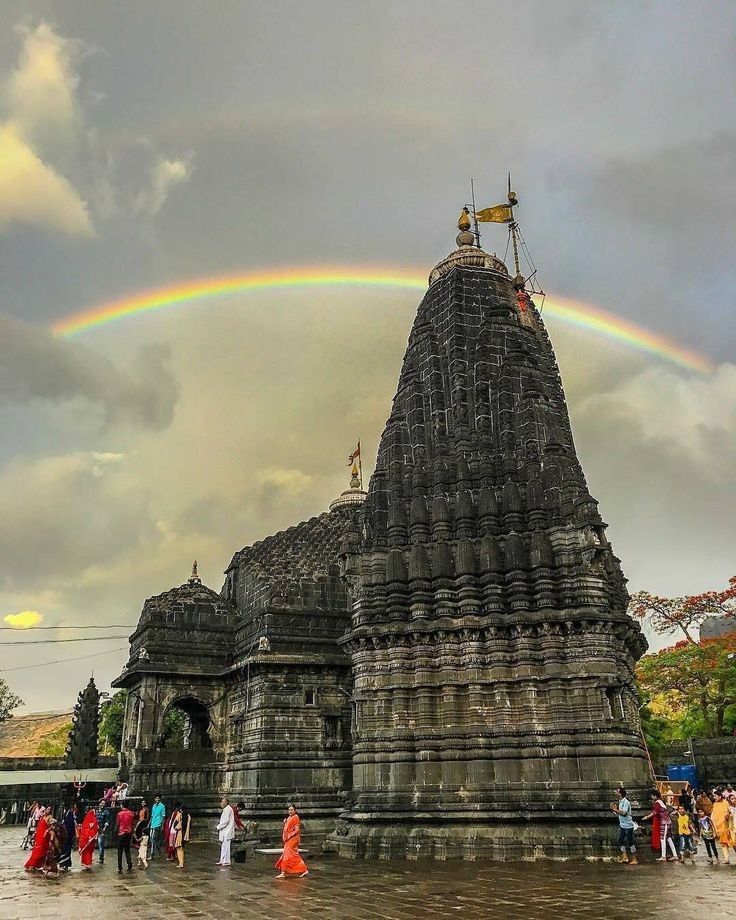
Trimbakeshwar Jyotirlinga Temple
Trimbakeshwar Jyotirlinga Temple in Nashik, Maharashtra — one of the twelve most sacred Shiva shrines in India, mentioned in the Shiva Purana.
About Trimbakeshwar Jyotirlinga Temple
Located near Nashik at the source of the Godavari River. The temple has a unique feature where the Jyotirlinga is set in a hollow space in the floor of the sanctum.
Trimbakeshwar Temple Mythology & Legend
The sage Gautama accidentally killed a cow and performed penance. Lord Shiva appeared and released the Ganga as the Godavari river. The three-faced lingam represents Brahma, Vishnu, and Shiva.
History of Trimbakeshwar Temple
The temple was constructed by Peshwa Balaji Bajirao in the 18th century. The unique Indo-Aryan architecture features a black stone temple with intricate carvings and a golden crown.
Trimbakeshwar Darshan Timings & Rituals
- Abhishekam performed by temple priests only
- Rudrabhishek on Mondays
- Special pujas during Shravan month
- Kumbh Mela held every 12 years
How to Reach Trimbakeshwar — Stay, Food & Travel Guide
Hotels & Accommodation Near Trimbakeshwar
- Hotels in Trimbakeshwar town
- Resorts near Nashik
- Dharamshalas near temple
- Budget lodges for pilgrims
Booking Tip: Visit platforms like MakeMyTrip, Booking.com, or Goibibo for online reservations.
Quick Information
Spiritual Significance of Trimbakeshwar
Discover the ancient Vedic importance, Puranic legends, and astrological remedies associated with the sacred Trimbakeshwar Jyotirlinga.
Associated Kaal Sarp Dosh
Shankhapal Kaal Sarp Dosh
Visiting this Jyotirlinga is traditionally prescribed as a powerful remedy for those born under or afflicted by this specific Kaal Sarp Dosh.
Vedic Importance & Puranic Legends
A unique three-headed cavity representing the Hindu Trinity: Brahma, Vishnu, and Mahesh. Tied to Sage Gautama bringing the holy river Godavari (Ganga of the South) to earth to cleanse a sin.
Why You Should Visit
Spiritual & Material Benefits
To resolve severe astrological curses including Kaal Sarp Dosha, Pitri Dosha, and Narayan Nagbali requirements. It is the absolute premier center for rectifying generational bloodline blockages.
The Complete Guide to Trimbakeshwar Jyotirlinga
Everything a pilgrim needs — a millennium of history, the specifics of the sanctum's architecture, the exact darshan procedure, the annual festival calendar, and practical tips born from experience on the ground.
A Thousand Years of History
Trimbakeshwar, located 28 km from Nashik in Maharashtra at the source of the Godavari river, is one of only two Jyotirlingas where the lingam is not a single stone but three natural thumb-sized rock cavities representing Brahma, Vishnu and Mahesh (Shiva) — a rare tri-murti embodiment. Puranic tradition attributes the temple's origin to Sage Gautama, who was falsely accused of killing a cow and performed penance to bring the Godavari (also called Ganga of the South) from Shiva's matted locks to Earth to absolve the sin. Adi Shankaracharya visited Trimbakeshwar in the eighth century and established one of the four Peethas nearby at Kanchipuram. The present temple structure was built between 1755 and 1786 by Peshwa Balaji Bajirao (Nanasaheb) in black basalt from the surrounding Brahmagiri hills. Trimbakeshwar is also famous as the only Jyotirlinga that performs the Narayan Nagbali, Kaal Sarp Dosh Nivaran, Tripindi Shraddh and Pitri Dosh rituals with full Vedic sanction — the priests here are the only ones authorised by shastric tradition to conduct these rites.
Architecture & Design of the Sanctum
The temple is a compact Hemadpanti-style shrine built in dressed black basalt, with a graceful Nagara-style shikhara. The sanctum is enclosed by a low sabha-mandapa where devotees have limited access — the lingam itself is placed in a shallow depression and viewed from a distance. The precinct is dominated by a large Amruta-varshini Kunda (elixir tank) that receives the naturally seeping Godavari water. The temple's outer walls carry beautifully preserved eighteenth-century friezes of the Ashta-Dikpalas, the Navagraha and scenes from the Ramayana.
Step-by-Step Darshan Procedure
- 1Enter through the main eastern gate after depositing footwear and mobile phones at the free cloakroom.
- 2Purchase a Sheeghra Darshan ticket (Rs. 200) at the temple's Bhakta Nivas counter for a faster queue.
- 3Sprinkle water from the Kushavarta Kund at the outer prakara — the traditional source of the Godavari.
- 4Enter the sabha-mandapa and view the tri-lingam through the silver arch; touching is not permitted.
- 5Perform pradakshina three times around the sanctum.
- 6Proceed to the adjoining Brahmagiri hill (3 km) for a trek to the exact source of the Godavari — an eight-hour round trip.
Annual Festival Calendar
Simhastha Kumbh Mela
One of the four sites of the Kumbh Mela, held every twelve years on the banks of the Godavari at Nashik-Trimbak; the next is scheduled for 2027.
Maha Shivratri
A special Rudra-abhishek is performed in the sanctum with 108 kalashas of Godavari water.
Nivrittinath Yatra
Devotees walk from Alandi to Trimbakeshwar during the Ashadh-Shukla Ekadashi in a 250-km-long procession of palkhis.
Insider Tips for Pilgrims
- Book Kaal Sarp Dosh, Nag-Bali or Tripindi Shraddh puja at least 15 days in advance through registered temple priests — the ritual takes 3 full days.
- Kushavarta Kund is where thousands take a ritual dip before the darshan — carry a change of clothes.
- Combine the visit with the Anjaneri hills (birthplace of Hanuman) and the Pandavleni caves in Nashik.
Essentials for Your Trimbakeshwar Yatra
Curated puja items, spiritual books, and travel essentials for pilgrims visiting Trimbakeshwar and other sacred Jyotirlinga temples. Delivered by Amazon India.
Rudraksha Mala
Original 108-bead prayer mala for daily japa
Puja Thali Set
Complete brass puja thali with all accessories
Shiva Purana
Sacred scripture of Lord Shiva in English
Brass Diya & Lamp
Traditional oil lamp for temple worship
Meditation Cushion
Zafu cushion for meditation & chanting
Pilgrimage Backpack
Durable 40L travel backpack for temple visits
Ethnic Wear
Traditional kurta, saree & salwar for pilgrims
Shiv Idols
Brass, marble & panchdhatu Shiva idols for puja
As an Amazon Associate, we earn from qualifying purchases — at no extra cost to you. Prices, availability, and product details are managed by Amazon.in.
Book Your Stay Near Trimbakeshwar
Plan your pilgrimage to Trimbakeshwar with our trusted hotel and travel partners. Compare deals and book directly with verified providers.
IndiGo Hotels
Premium hotel deals across India
Cleartrip
Flights, hotels & holiday packages
Booking.com
Worldwide hotels & accommodation
Agoda
Hotels & resorts at best prices
Disclosure: We may earn an affiliate commission when you book through these partners — at no extra cost to you. This helps us keep the Jyotirlinga guide free.
Trimbakeshwar Jyotirlinga — Your Questions Answered
Practical, spiritual and travel questions asked most often by first-time pilgrims to Trimbakeshwar.
What Pilgrims Say About Trimbakeshwar
Be the first to share your darshan experience.
Explore Other Sacred Jyotirlingas
Continue your spiritual journey across India by visiting the other sacred Jyotirlinga shrines of Lord Shiva.